
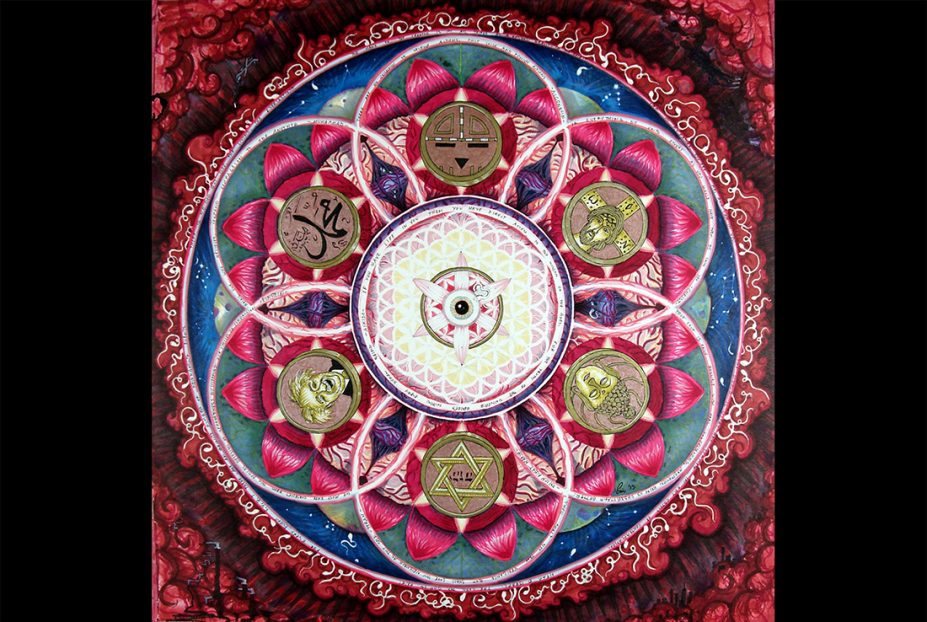
The saint Rabia said “I do not desire heaven and I do not fear hell, I want only Allah.” In the testaments, the holy books, the Torah, the New Testament, the Quran, there are stories of prophets. The prophets had connections with Allah. In the Old Testament, Allah spoke to Abraham, Allah spoke to Moses, Allah had direct connection to people on earth. In the New Testament, the Christian version is that Allah’s connection to earth and the people on it is so great that he sent a son, his only son on earth, to be among the people — to tell the truth of who He was. In the Quran, Muhammad (p.b.u.h.) goes directly to visit Allah. In addition to the revelation coming to him and through him, there was a direct journey to Allah. It is called the Mi’raj. He went from Jerusalem to the seat of Allah and back to Jerusalem. In the formal prayer, or as they are sometimes called the prescribed prayers, in Islam, there is a portion of that prayer which is a portion of the Mi’raj and what occurred in Heaven between the Prophet (p.b.u.h.) the angels and Allah. It occurs when you sit down. It begins in the recitation when you sit down, which in translation is “All acts of worship are for Allah.” This is what the Prophet said. Then it goes on to “Allah’s peace be upon you, O Prophet and his mercy and blessings.” This is what the angels say to the Prophet. To which the Prophet responds “Peace be on us all, the righteous servants of Allah.” Then the Prophet says further “I bear witness that there is not God but Allah.” That the angels, and some say maybe even God says, “and I bear witness that Mohammed is his servant and messenger.”
So we have the Mi’raj as part of our daily ritual, or prescribed five times per day. It’s actualy done more than that if you do all of the different sets of prayers. You say it quite a few times during the day. What’s the point? Why are we asked to repeat the Mi’raj? Why are we asked to repeat what occurred?
Well, in terms that we can understand, it is necessary for us that we believe that that which occurred, which was man meeting Allah, is something that we are supposed to be keenly aware of. That’s why we repeat it so many times during the day. Not only are we to be keenly aware of it, we are supposed to believe in its possibility and its probability. For who? For us.
This is one of the core understandings within Sufism. Your Covenant, besides with the religion and besides with the Prophet is directly with Allah. The end result of that Covenant, the end result of this journey is that meeting with Allah.
In Sufism it is said, only Allah can commune with Allah, only Allah can know Allah, only Allah can truly can truly pray to Allah. The meaning of that is, unless you are in a state of purity and a state of Allah’s qualities, the distance between you and Allah is great. To lessen that distance, we have to purify ourselves, understand the qualities and incorporate those qualities in us. It’s only then that we can understand reality because you can’t understand something that you are not. You can’t be something that yo aren’t. You can’t have contact with something that you don’t understand. To truly pray, you have to under who you are praying to. To truly understand who you are praying to, you have to become like the one you are praying to. To truly pray, it means becoming that example. To truly pray, it means becoming that which you pray to. An incorporation is there, the final unity occurs.
In the creation, Allah gave off. What He gave off was creation. Creation is elemental. Allah is not elemental…