
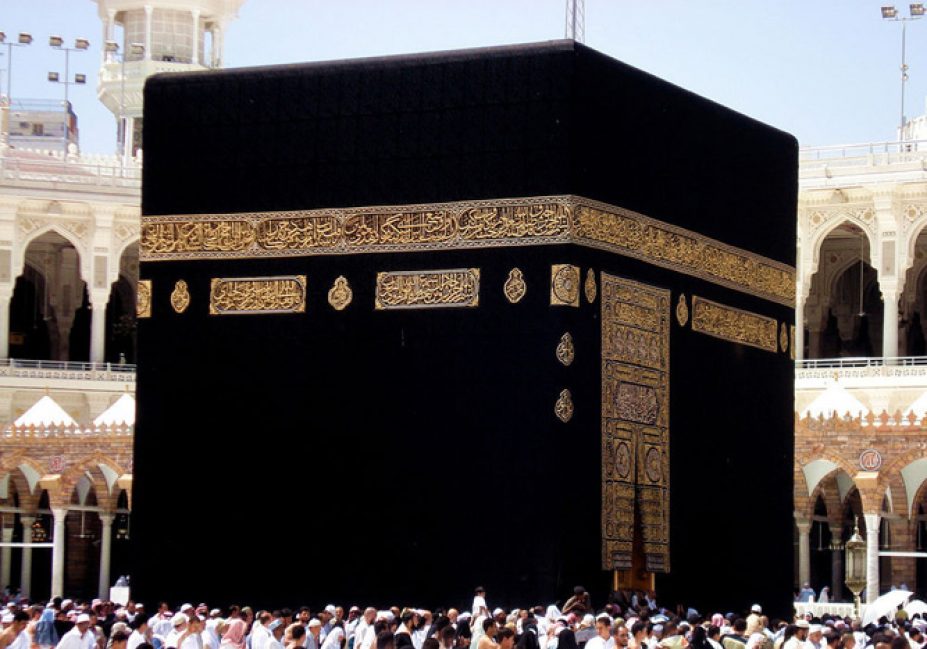
What is the meaning of pilgrimage, how did it begin, why do we go on pilgrimage? It began when the prophet Abraham came to visit his son and together they built the first house of God. Abraham told his son it would be a place of pilgrimage for all those who believed in one God; it did become a holy place, it remained a place of remembrance for a long time. Later, when belief in one God was lost in paganism and people worshiped many deities, God’s house became a temple for many gods. They worshiped idols but it remained a temple, a place of reverence without understanding.
When the monotheist rituals of Abraham were restored by Muhammad, this was a problem for those who had earned their living from all the tribes who came there to worship their gods. But today’s pilgrimage re-creates what Abraham did, today’s ritual is an imitation of Abraham. Imitation is interesting, it is an act of becoming, redoing, joining, melting into. Now this ritual is performed attempting to imitate what two prophets, what Abraham and Muhammad both did. Pilgrims walk in the steps of Muhammad who walked in the steps of Abraham. The point here is continuity, nothing new, a re-creation of an ancient observance, pilgrims declaring themselves to be of that lineage, part of that continuity, the truth which has always existed.
Imitation is the act of becoming what existed before. There is a story here to illustrate this point, a story about an enlightened teacher called John. His disciple Michael was running around town shouting, “I’m John, I’m John!”
Some of the other disciples reported this to the master, “Michael is running around town telling everyone he is John, talk to him about this.”
The teacher replied, “I’ll talk to him when he comes back.” Then when Michael returned he sat them all down before him, “The other dervishes tell me you are running around town saying you are John. You should all be running around town saying you are John, you should all become John!”
This is a central understanding of the path, we all need to become the innermost part of our enlightened master, we need to imitate him, be like him, become him. In the long tradition of reinforcing what existed before us, walking in the steps of those who came before us, being in the way of what came before us, we can be in the way of God; if we get in His way enough we will bump into Him. We need to be in His way, we have examples of those who have been in His way. We should be in His way and love each other as we love those who are in His way, love each other as enlightened beings have taught us to love. In that love our true grace, our glory exists. If we are incapable of wakening that love, bringing it to fruition, we cannot be in His way.
One characteristic of certain enlightened teachers is their ability to love strangers, they have the capacity to love people they do not know, they love them, give them attention and sympathy, listening to their problems as if they were the only problems in the world. Do we give ourself to our companions that way, give ourself to those who come our way?
This is what the great luminous beings do, they come to dispense love, they plant love in the heart of every person they meet. They plant love by being love, nothing more, just the transcendent state of being which elevates all those who come near. If we are going to follow this path we are obliged to do that too, this love should grow in us, we should be able to love others. Reach a point where this love begins to live, it exists within us, call it up and use it. If it is so hidden we have lost touch with it we must uncover it, learn to respect ourself and the dignity of others. We need to dignify ourself with that love, understanding it in such a way that we can be appropriate inwardly and then outwardly with others. Have the dignity of that love, learn to give it to others, be the dignity we offer.
Can we imagine any more dignity than God Himself has, can we imagine His representatives without dignity, without the calm strength or the qualities which make us want to be their companion? If we want to walk in the steps of the holy ones, if we want to imitate the prophets we have to adopt their qualities, the love, the kindness, the tolerance, compassion and mercy, all the qualities which give dignity to others, which encourage their growth as true human beings.
We do not make a child mature by beating it, we do not help our friends by berating them, we do not create good relationships in our household by shouting at our wife or husband. They say that half the path to purity lies in marriage because here we have an opportunity for a deep, close relationship where we can treat each other with dignity, we can treat each other in an exalted human way with the qualities of God. If we cannot do this at home we cannot do it at all.
Most people seem to have only one kind of relationship, one they repeat again and again with everyone they know. Since we create it, we ought to establish what that relationship should be because we have models of what it could be, models we can to imitate until we become that model. This is a process of becoming. Let us ask each other what we are becoming, what we intend to become.
Intention is important, it is the first step and part of every other step we take. If intention is tied to the self, to self-importance, self-gratification, things of the lower self, actions coming from that intention will always be impure. We have to cleanse our motives and cleanse ourself with constant vigilance, understanding why we do things—the reason is relevant. We have to correct that reason, check our motives, be clean. There is a reason why we are supposed to wash, a reason why we have rituals of water in the religions, a reason for all this washing. We need to cleanse ourself repeatedly, cleanse our motives and our lower self, self-interest, desire, the things we think we need, the things we want.
Someone who does not want anything worldly is empty of such needs. If we have no individual need or will, no motive or desire, we can be filled with the qualities and the will of God. If the qualities of God become who we are, these qualities engage the actions of God; when our actions are no longer ours, the qualities become the duties of God, duties we no longer perform for ourself.
God does not only live in us, He lives through us, He must pass through us which means we have to be empty. We need to be empty and stay empty: being empty once does not mean we necessarily stay empty, there must be nonstop vigilance. Even great teachers have lost their way with a moment of indulgence, they did not maintain a state of emptiness.
To understand pilgrimage, to understand what the prophets did, the steps they took, we need to take the same steps, walk together with those who took them before, with those who walked for Him. When we understand this we understand all moments are the same, all time is the same. Know the nature of this existence, know what comes and what goes, know how we fit into the scheme of things. Everything goes yet everything remains. God is always with us, with every breath we are created again. If He abandoned His sustenance of everything in existence for a moment, it would all disappear. Understand the connection we have to our Lord, exult in it, praise it. We must be thankful, have gratitude, be gracious. One way to show our gratitude lies in our actions with others, those around us, those we meet. We show our gratitude by remaining empty, without thinking that something is missing, that we need something, without thinking we need to create more for ourself because it has all already been given. When we do not we create the veils that keep Him from us He lives within us.
May our faith be strong, may certitude and our determination be strong. May He show us this straight, true path and make our steps easy.